Wellness
November 24, 2026
Last week you pulled a clump of hair out of the shower drain and wondered if you should be concerned. Maybe your comb has looked fuller lately, or your ponytail feels a little less substantial than it did a year ago. Nearly everyone goes through this moment at some point, and the question that follows is always the same: is this normal, or is something wrong?
The honest answer is that it depends. A certain amount of shedding is just how hair works. But when the shedding gets heavy, the scalp starts showing, or bald spots appear, your body may be telling you something worth listening to.
Losing 50 to 100 hairs a day is typical. Each hair grows for a few years, rests for a bit, then falls out while a fresh one starts growing in its place. Because all of this happens at different times across your scalp, you never notice a dramatic change in volume.
Wash days tend to look worse than they are. Hairs that were already loose get dislodged when you shampoo, oil or comb, so skipping a wash for a few days means a bigger pile when you finally do it. It looks like a lot, but it’s mostly the same daily shedding collected in one go.
Rather than counting strands, watch for changes over time:
Your ponytail feels thinner than before
Your parting looks wider
Your scalp is easier to see, especially under bright light
Your brush or pillow collects far more hair than it used to
One odd week isn’t a concern. A pattern that continues for weeks or months is.
Most of us use the two phrases interchangeably, but dermatologists draw a line between them.
Hair fall is shedding. Hairs drop out, but the follicles are healthy and new hair keeps coming. Shedding can spike after a fever, a rough few months or a hormonal shift, then settle down on its own.
Hair loss is when regrowth doesn’t keep up. Follicles may shrink, become inflamed or get damaged, so the hair that falls out isn’t replaced properly.
In everyday life, it looks something like this:
Normal shedding: strands fall, but your overall thickness stays the same Heavy shedding: noticeably more hair comes out, usually evenly across the whole scalp Pattern thinning: the crown slowly thins, the parting widens, or the hairline moves back
Patchy loss: hair vanishes from defined spots, often quite suddenly
It’s possible to have more than one of these at once, which is exactly why a doctor looks for the cause rather than just measuring how much hair is lost.
People often blame their shampoo, but the real reason usually lies deeper.
Low nutrition. Hair needs protein, iron and other nutrients to grow well. Crash diets, sudden weight loss and long-term deficiencies can all push hair into a shedding phase.
Thyroid trouble. Both an underactive and an overactive thyroid interfere with the hair cycle. You might also feel tired, notice your weight changing, or find that you’re oddly sensitive to heat or cold.
PCOS. The hormonal imbalance in polycystic ovary syndrome can cause thinning around the crown and along the parting. Some women also see acne or irregular periods.
Stress, physical or emotional. Surgery, a high fever, grief or months of pressure can shove a lot of hairs into the resting phase together. The catch is the delay. Shedding often begins two to three months later, so the link isn’t obvious.
Childbirth. Falling hormone levels after delivery commonly lead to heavy shedding. It usually improves gradually, though how long that takes differs from woman to woman.
Once the trigger is found, treatment can be aimed at it directly, which works far better than covering up the problem.
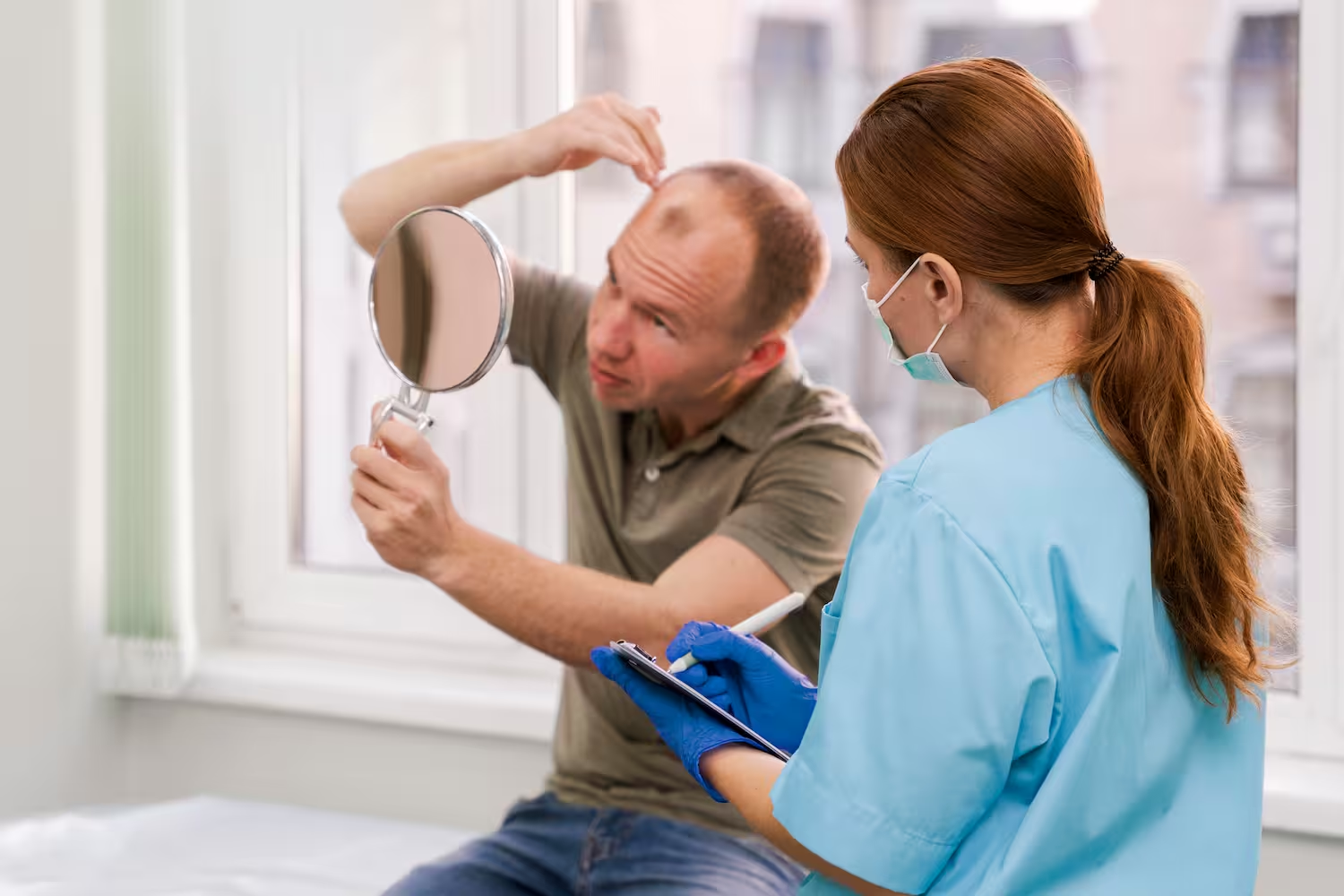
Telogen effluvium happens when a large number of follicles enter the resting phase at the same time. Illness, stress, childbirth or sudden diet changes often start it. In many people the hair grows back once the cause has been dealt with.
Androgenetic alopecia is the common male or female pattern loss, shaped by genetics and hormones. Men usually notice a receding hairline or a thinning crown, while women tend to see a wider parting. Catching it early gives the best chance of slowing it down.
Alopecia areata is autoimmune. The body’s defence system mistakenly attacks hair follicles, causing smooth, well-defined bald patches. It can appear on the scalp, beard, eyebrows and elsewhere.
Each has a different cause and a different approach, so getting an accurate diagnosis should come before starting any hair loss treatment.
Expect a conversation first. The doctor will ask about your health history, diet, medicines, routine and whether hair loss runs in your family. Then comes a close look at your scalp, and sometimes a few tests:
Complete blood count (CBC): checks for anaemia
Serum ferritin: shows how much iron your body has stored
Thyroid tests: rule thyroid problems in or out
Vitamin B12 and D levels: useful if a deficiency is suspected
Hormone tests: mainly when PCOS or androgen-related thinning is a possibility Trichoscopy: a magnified scalp exam that shows follicle health, density and thinning patterns
You won’t necessarily need all of these. The doctor chooses based on your symptoms, and a proper diagnosis can save you from buying supplements and products you never needed.
No single treatment suits everyone, so what’s recommended depends on what’s causing your hair loss.
PRP therapy. A little of your own blood is processed to concentrate its platelets, and the result is injected into areas of the scalp. Research suggests it can improve density for some people with pattern hair loss. Several sessions are normally needed, and results differ.
Mesotherapy. Tiny injections place selected substances into the scalp. It’s offeredfor thinning, but the evidence behind it is still limited. If it’s suggested, ask what’s in it, what the risks are and what outcome is realistic.
Medication. Depending on the diagnosis, your doctor may recommend topical minoxidil or other prescription treatments. They can slow thinning or support regrowth, but only when used consistently under medical supervision.
Low-level laser therapy. Light of specific wavelengths is used to stimulate follicles. Benefits tend to be modest, and repeat sessions are usually part of the plan.
If you’re searching for hair loss treatment in Kochi or Tirur, choose a plan built on a confirmed diagnosis, not on whatever trend is circulating online.
Giving it a little time is fine, and shedding does sometimes stop by itself. But please book a consultation if you notice any of these:
Sudden, unusually heavy shedding
Hair fall that has lasted several months
Thinning you can clearly see, or a widening parting
Round or irregular bald patches
Itching, redness, pain or flaking on the scalp
Hair changes along with tiredness, irregular periods or other health issues
If the loss is fast, or the scalp looks inflamed or scarred, don’t delay.
Hair fall isn’t always a sign of trouble. But ongoing hair loss shouldn’t be shrugged off as something you simply have to accept. Trying one shampoo, oil or home remedy after another rarely helps as much as understanding why it’s happening in the first place.
If you’re looking for a skin clinic in Kochi or a skin clinic in Tirur, Sage Skin & Hair Clinic offers professional dermatological evaluation and can help you explore hair and scalp care suited to you. Whether your shedding turns out to be temporary or the start of gradual thinning, a plan shaped around your own situation is the best starting point.
Healthy hair begins with a healthy scalp. Speak to a qualified dermatologist and take that first step.


