Wellness
August 17, 2026
When we think about facial aging, attention usually goes to wrinkles, sagging cheeks, or
under-eye changes. Yet the lips and the skin surrounding the mouth can show age in their
own distinctive way. Gradually, lips may appear thinner, the border can become less defined,
fine lines may develop, and the natural colour or texture may change.
These changes do not always require dramatic correction. Modern lip rejuvenation focuses
increasingly on maintaining proportion, restoring lost definition, improving texture, and
supporting natural-looking results.
For people searching for the best skin clinic in Kochi or the best skin clinic in Tirur,
understanding why the lips change with age is an important first step before choosing
treatments such as skin rejuvenation procedures or lip augmentation.
The lips are structurally different from ordinary facial skin. The visible pink or reddish portion
of the lips has a relatively delicate surface and is constantly exposed to movement,
environmental conditions, saliva, cosmetics, food, and sunlight.
With age, several changes can happen simultaneously. The tissues around the mouth can
lose volume and structural support, while changes in collagen and other components of the
skin contributes to altered texture and appearance. Research on lip aging describes changes
involving lip shape, volume, surface characteristics, and the surrounding perioral area.
The result may not simply be “smaller lips.” The upper lip can appear longer, the lip border
may look softer, and the overall balance between the lips and surrounding facial features can
gradually shift.
This is why successful anti-aging lip treatment should consider the entire lip area rather than
focusing only on adding volume.
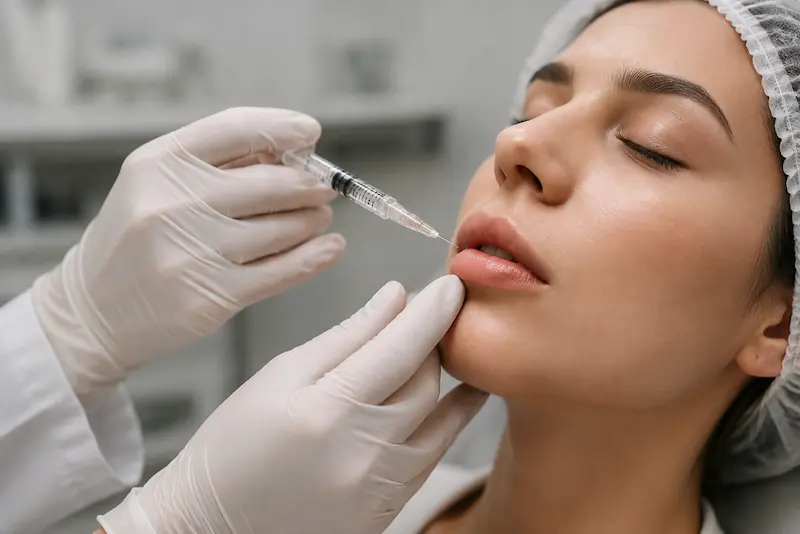
One of the most noticeable age-related changes is reduced fullness.
Some people naturally have thin lips from a young age, whereas others notice that
previously fuller lips become flatter with time. At the same time, the Cupid’s bow and
Vermilion border may become less prominent.
Fine vertical lines can also appear around the mouth. Repeated movements involved in
speaking, eating, smiling, and facial expression contribute to how this area changes over
many years, while age-related tissue changes and environmental exposure can make lines
increasingly visible.
Treatment therefore depends on what is actually causing concern.
A person with volume loss may benefit from a different approach than someone whose
The primary concern is fine lines, dryness, uneven texture, or reduced lip definition.
At Sage, a personalized assessment can help determine whether the priority should be
hydration and skin quality, pigmentation management, perioral rejuvenation, subtle definition,
or lip augmentation.
Not every change in the lips is related to volume.
Darkening or uneven pigmentation can occur for several reasons. Natural pigmentation
varies significantly between individuals, while irritation, inflammation, sun exposure, certain
products, habits, and some medical conditions can also influence color.
Contact reactions to lip cosmetics and personal-care products, for example, have been
associated with pigmented contact cheilitis.
Because several conditions can produce similar-looking pigmentation, treating dark lips
without identifying the underlying cause may lead to disappointing results or further irritation.
A dermatologist may first evaluate the pattern and history of pigmentation before
recommending treatment. Depending on the diagnosis, management can include removing
possible irritants, improving sun protection, using carefully selected topical treatment, or
considering dermatologist-supervised procedures.
Certain laser approaches have been studied for lip pigmentation, but results vary and
treatment parameters require careful selection, particularly because inappropriate treatment
can itself cause pigmentary changes.
Lip rejuvenation does not automatically mean fillers.
For early signs of aging, dryness, roughness, mild pigmentation, or changes around the
mouth, non-injectable care may sometimes be more appropriate.
The foundation is protecting the lip barrier. Regular use of a non-irritating moisturising lip
product can help reduce dryness and cracking. Sun protection is equally important. The
American Academy of Dermatology recommends lip balm with SPF 30 or higher when
protecting the lips from ultraviolet exposure.
In-clinic treatment may also be considered for specific concerns around the lips. Depending
on an individual's skin type and diagnosis, a dermatologist may discuss carefully selected
resurfacing, pigmentation treatments, or other rejuvenation procedures.
The objective should be improving the quality and appearance of the area without
unnecessary treatment.
For people experiencing noticeable loss of lip volume or definition, dermal fillers can provide
another option.
Hyaluronic acid-based fillers are widely used for non-surgical lip augmentation. Research
indicates that they can increase lip fullness, although results are temporary and longevity
differs according to the product, technique, individual metabolism, and other factors.
Modern lip augmentation is not simply about creating bigger lips.
Treatment can be planned to address several details, including restoring subtle volume,
improving the lip border, supporting symmetry, enhancing the Cupid’s bow, or balancing the
upper and lower lips.
For mature lips in particular, conservative correction can often be more aesthetically
appropriate than excessive volume. Facial proportions, existing lip anatomy, age-related
changes, and the patient’s expectations all need to be considered before treatment.
Dermal fillers are medical procedures and are not risk-free. Temporary swelling, tenderness,
redness, bruising, and discomfort can occur. Rare but serious complications are also
possible, which is why fillers should be administered by appropriately qualified medical
professionals familiar with facial anatomy and complication management.
Lip rejuvenation should not begin and end with a clinic procedure.
Everyday habits can play an important role in keeping the lips comfortable and protecting
their appearance.
Use a gentle, non-irritating lip moisturizer regularly and avoid repeatedly licking dry lips.
Protect the lips from UV exposure with SPF 30 or higher, particularly when spending
extended periods outdoors. If a particular lipstick, balm, or cosmetic repeatedly causes
burning, itching, scaling, or darkening, discontinue it and consider a dermatology
Consultation.
Persistent sores, unexplained colour changes, recurrent cracking, scaling, or lesions that do
not heal should not simply be treated as cosmetic aging. They require proper medical
Evaluation.
There is no single anti-aging lip treatment suitable for everyone.
One person may need nothing more than improved barrier care and sun protection. Another
may benefit from treatment for pigmentation, while someone experiencing age-related
volume loss may consider carefully planned lip augmentation.
The goal should not be to erase every sign of age or create an artificial lip shape. A more
refined approach is to preserve individual features while improving concerns that genuinely
bother the patient.
If you are searching for the best skin clinic in Kochi or the best skin clinic in Tirur for lip
rejuvenation, look for an approach that begins with medical assessment rather than
automatically recommending a procedure.
At Sage Skin & Hair Clinic, lip concerns can be evaluated according to your anatomy, skin
condition, pigmentation, age-related changes, and aesthetic goals before an appropriate
treatment plan is considered.
Healthy, well-cared-for lips are not necessarily the largest or perfectly smoothest lips. They
are lips that remain comfortable, balanced, protected, and naturally suited to your face.


